

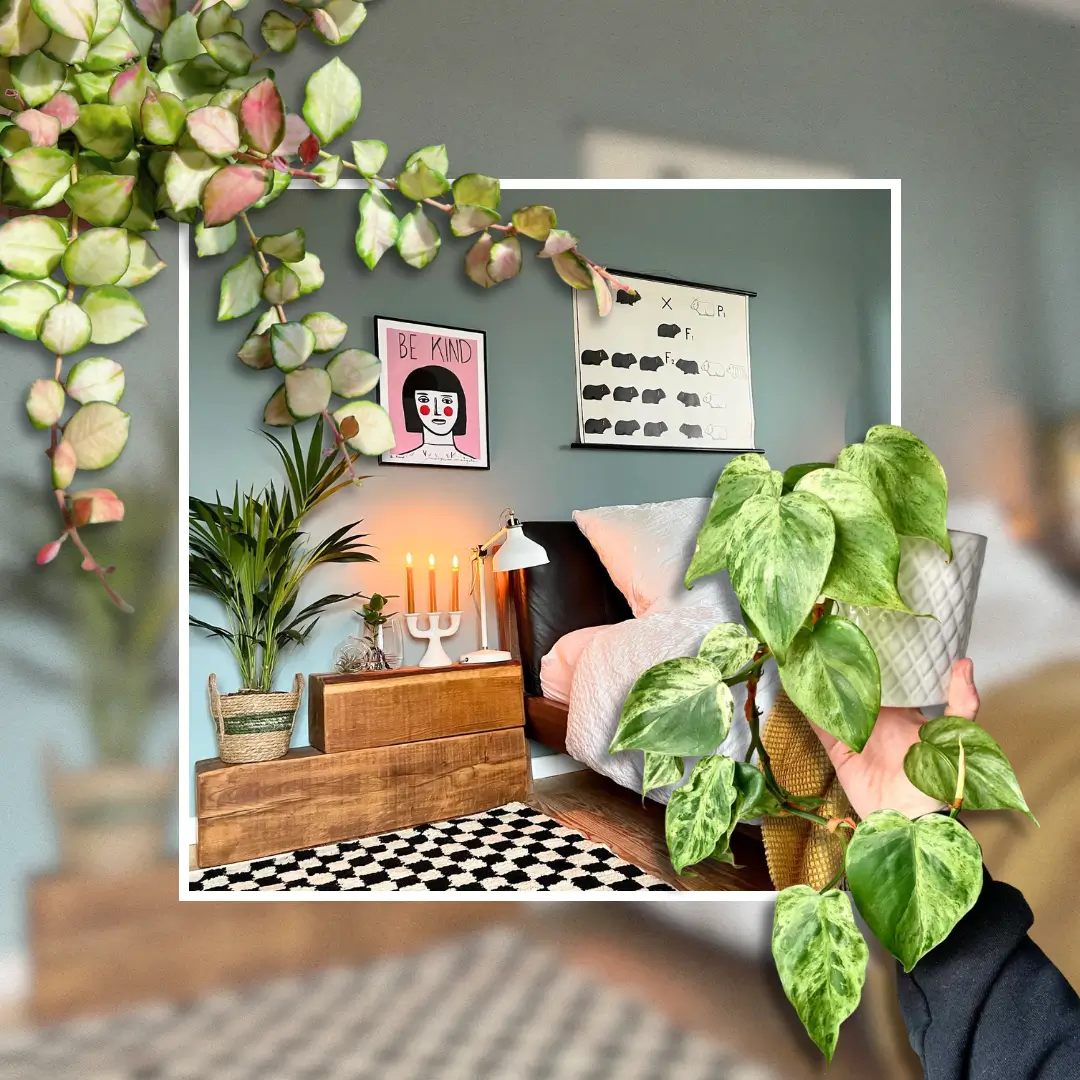
My bedroom gets exactly one window’s worth of light, and it faces a wall.
For a long time I assumed that ruled out plants entirely, so the corner by my wardrobe stayed empty and the room stayed slightly unfinished in a way I could never quite name.
Turns out bedrooms are one of the easier rooms to get right, as long as you pick for the room you have, rather than the room you’d like.
PIN FOR LATER 📌
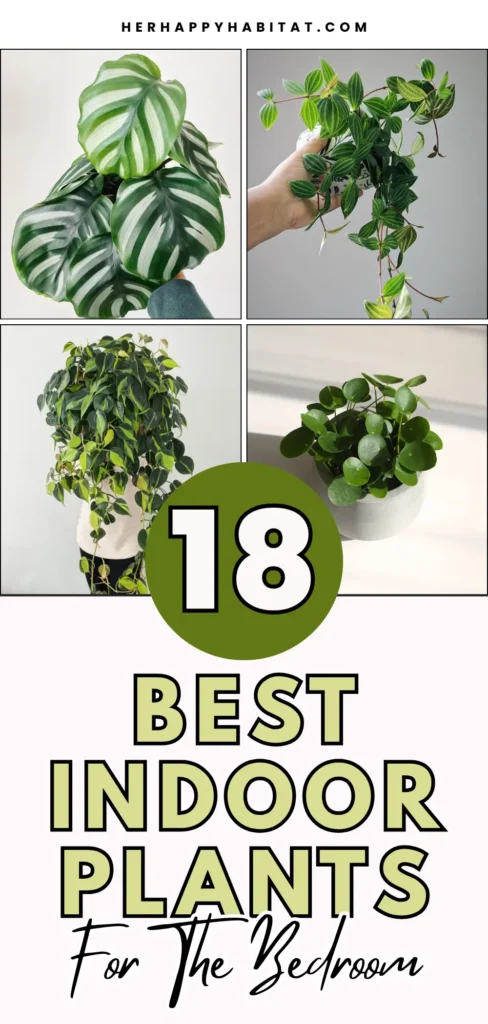
Bedrooms are dim, they’re cooler than the rest of the house, and they’re the room you’re least likely to walk into with a watering can.
Pick for those conditions instead of against them, and the whole thing gets simple.
So here are the best indoor plants for a bedroom, sorted by the light you’re actually working with.
There are low-light bedroom plants for rooms like mine, pet-safe options if something sleeps on your bed, trailing plants for a shelf, and a couple of big ones for an empty corner.
Low-Light Bedroom Plants
1. Snake Plant
The one everyone recommends, and for once the hype is deserved.
It handles a dim corner, it forgives you for going away for two weeks, and the upright leaves give you height without taking up floor space.
It’s also the plant behind most of the “releases oxygen at night” claims, which has a grain of truth to it (more on that below).
Toxic to cats and dogs if chewed.




2. ZZ Plant
Glossy, architectural, and close to unkillable.
The thick rhizomes under the soil store water, so the main way people lose a ZZ plant is by watering it too often. If your bedroom is dark and you travel, this is the pick.
Toxic to pets.
3. Pothos
The plant that made me think I might be good at this.
It trails, it roots from cuttings in a glass of water, and it will grow in genuinely poor light.
Golden pothos loses some of its variegation in a dark room and goes greener, which I actually prefer.
Toxic to pets.
4. Cast Iron Plant
Named for exactly the reason you’d guess.
Victorian households kept these alive in gaslit hallways, which tells you everything about its tolerance for gloom. It grows slowly, so buy it at the size you want it.
Pet safe.
5. Heartleaf Philodendron
Softer looking than a pothos and just as forgiving, with deep green heart-shaped leaves that trail happily off a dresser.
It grows fast enough to feel rewarding, which matters if you’ve killed things before.
Toxic to pets.
Pet-Safe Bedroom Plants
6. Parlor Palm
The pet-safe plant I recommend most.
It brings that soft, feathery palm look without needing a conservatory, and it tolerates medium to low light better than almost any other palm.
Slow-growing and undramatic in the best way.
7. Spider Plant
Pet safe, fast, and generous with the baby plantlets, which you can pot up and give away or use to fill the rest of the house for free.
It does want a reasonably bright spot, so this is one for a bedroom with a real window rather than a dark one.
8. Calathea
Pet safe and genuinely beautiful, with patterned leaves that fold up at night.
Being straight with you: calatheas are fussy.
They want humidity, they sulk at tap water, and they’ll brown at the edges to let you know.
Worth it if you enjoy the fiddling, skip it if you don’t.
9. Peperomia
Small, pet-safe, and quietly excellent.
There are dozens of varieties, from ripple-leaved to trailing, so you can pick one that suits the shelf you have in mind.
Thick leaves mean it stores water and won’t punish you for forgetting.
10. Boston Fern
Lush, soft, and very pet safe.
The catch is humidity: most bedrooms are drier than a fern would like, especially with heating on.
If you’re prepared to mist it or keep it near a humidifier, it’s lovely. If not, the parlor palm gives you a similar look for less effort.
Trailing Plants for Shelves and Headboards
11. String of Hearts
Delicate trailing vines with tiny heart-shaped leaves are one of the prettiest things you can hang above a bed.
It needs decent light to keep the leaves close together, so put it near your window rather than in the dark corner.
Pet safe.
12. Hoya
Waxy, thick-leaved, and slow in a way that suits a bedroom.
Give it a bright spot and it may eventually reward you with clusters of flowers that look almost fake.
Pet safe and very tolerant of neglect.
13. Philodendron Brasil
The variegated cousin of the heartleaf, with green and lime-striped leaves.
It needs a bit more light than the plain green version to keep that variegation, but it’s still forgiving.
Toxic to pets.
14. English Ivy
Classic, fast, and one of the few trailing plants that genuinely handles low light.
Two warnings: it’s toxic to pets, and it grows aggressively enough that you’ll be trimming it.
Beautiful when cascading off a wardrobe if you can stay on top of it.
Small Plants for a Bedside Table
15. Haworthia
A tidy little succulent with translucent striped leaves, small enough to sit next to a lamp and not compete with it.
It wants brighter light than most plants here, so a bedside table by the window is ideal.
Pet safe.
16. Chinese Money Plant
Round, flat leaves on thin stems, instantly recognizable from every interior photo of the last decade.
It’s pet safe, it stays compact, and it produces offshoots you can pot up.
Prefers bright indirect light, so pair it with a window.
Big Bedroom Plants for an Empty Corner
17. Kentia Palm
If you have a bare corner and a budget, this is the one.
It’s tall, elegant, tolerates lower light than most large plants, and it’s pet safe.
Expensive, because it grows slowly, but it fills a room like nothing else on this list.
18. Rubber Plant
Big glossy burgundy-tinged leaves and a strong upright shape that anchors a room.
It wants bright indirect light to stay full rather than leggy, so put it near the window rather than in the dark corner.
The sap irritates skin, and it’s toxic to pets.
Bedroom Plant Questions, Answered Honestly
Yes. This worry comes from the fact that plants take in CO₂ and release oxygen during the day, then do a small amount of the reverse at night. The amount of CO₂ a houseplant releases overnight is tiny, far less than what you produce yourself while sleeping, or a partner, or a cat on the end of the bed. A room full of plants is not going to affect the air you breathe in any way you’d notice.
Snake plants, aloe, most succulents, and orchids use a type of photosynthesis called CAM, which means they take in CO₂ overnight rather than during the day. So the claim has a real basis. What gets left out is scale: the quantity involved is far too small to change the air in a bedroom. Pick these plants because they look good and survive neglect, not because you’re expecting a measurable oxygen boost.
Barely. Almost every article claiming they do traces back to a NASA study from 1989, which sealed single plants in chambers roughly the size of a shoebox. In a real room with real airflow, researchers have calculated you’d need something in the region of one plant per square foot to match what you get from simply opening a window. Plants are worth having for how they make a room feel. Air purification is not the reason.
A few genuine ones to avoid:
– Anything toxic if you have pets or small children. Lilies are the serious ones, since they’re severely toxic to cats even in small amounts.
– Heavily scented plants like gardenia or jasmine. Lovely in a hallway, a lot to sleep next to.
– High-humidity plants if your bedroom is dry and heated, since you’ll be fighting the room all winter.
– Anything sitting in constantly damp soil, which is how you end up with fungus gnats above your bed.
There’s no correct number, and any article giving you one is working backward from the air-purifying claim, which doesn’t hold up anyway.
Start with one plant in the spot that feels emptiest, see how you do with it, and add from there. Three or four well-placed plants make a room feel considered. Twenty would be chaos!
ALSO WORTH A LOOK: