
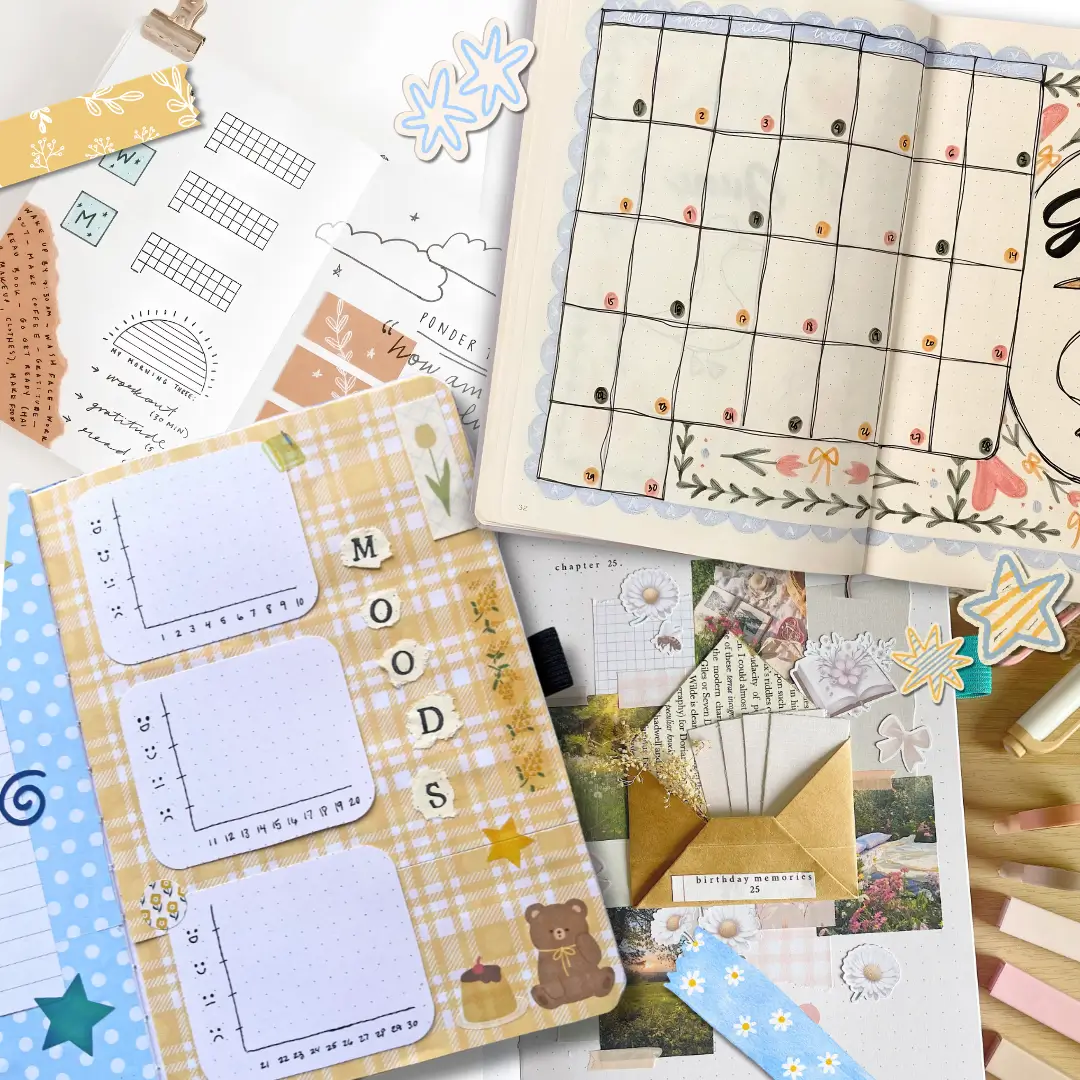
You’ve seen the photos. Gorgeous spreads, color-coded habit trackers, hand-lettered headers, and tiny doodles in the margins.
Bullet journaling looks like a full-time art project, and if you’ve been watching from the sidelines thinking there is no way I have the time, skill, or patience for that—I get it completely!
But bullet journaling was never really meant to look like that. The original system is actually pretty bare-bones.
PIN FOR LATER 📌
A notebook, a pen, a few simple symbols. The Pinterest-worthy spreads came later, created by people who genuinely enjoy that side of it.
But you don’t have to be one of those people for bullet journaling to change how you organize your life.
This post covers everything you need to know to actually get started—what bullet journaling is, what goes in one, which spreads to try first, and more than 20 bullet journal ideas for beginners that you can use immediately.
No calligraphy required.
What Is a Bullet Journal?

A bullet journal is a fully customizable planning system that works as a to-do list, diary, planner, and tracker all rolled into one notebook.
It was created by designer Ryder Carroll, who developed it as a way to manage his own ADHD and need for flexible organization—and the concept took off because it solves a problem a lot of people have: standard planners are too rigid and never quite fit how your brain actually works.
The core idea is simple. Instead of buying a pre-formatted planner with boxes that may or may not match your life, you build your own system from scratch.
You add what you need. Skip what you don’t. Change it every month if you want to.
That flexibility is exactly why it works so well for beginners too. You’re not locked into doing it a specific way. You just start, see what works, and adjust.
What You Need to Get Started
Good news: you probably already have everything you need.
- A notebook. Dotted grid notebooks are the most popular choice for bullet journaling because the dots give you a guide without being as structured as lines—great for drawing boxes, columns, and trackers without them looking messy. Leuchtturm1917 and Scribbles That Matter are favorites in the community, but honestly, any notebook works. If you have one sitting in a drawer right now, start there.
- A pen. Any pen. A basic ballpoint is completely fine. If you want cleaner lines as you get more comfortable, a fineliner like a Staedtler or Micron is worth picking up—but it is not a requirement for starting.
- Optional extras. Once you’re a few months in and enjoying it, you might want to add washi tape for decoration, colored pens or markers for headers and trackers, a ruler for straight lines, and stencils for lettering or shapes. These are nice-to-haves, not starting essentials. Don’t let the supplies be the reason you don’t begin.
That’s it. Two things. Let’s go.
The Core Bullet Journal Spreads Explained
Before we get into the ideas, it helps to understand the basic building blocks of bullet journaling. These four spreads are the foundation of the system. Think of them as the structure that holds everything else together.
The Future Log
The future log is your year-at-a-glance. It usually lives at the front of your journal and covers all twelve months in a condensed format—a couple of lines or a small calendar block for each one. Anything that happens more than a month away gets captured here first, then moved into the relevant monthly log when that month arrives.
It keeps you from forgetting things that are too far away to be on your radar right now but too important to lose. Think about a friend’s birthday four months out, a trip you’re planning, or a work deadline in the autumn.
The Monthly Log
At the start of each new month, you set up a monthly log. This is typically two pages: one with the dates of the month listed out (sometimes with a small calendar), and one as your task list for the month. It’s the bridge between your future log (the big picture) and your daily log (the day-to-day).
Your monthly log is also where most people put their habit trackers, mood trackers, and any monthly goals—though you’ll find your own rhythm for where things live.
The Daily Log
This is the heartbeat of bullet journaling and what Ryder Carroll originally designed the system around. The daily log is a running list of everything happening on a given day: tasks, events, notes, and anything else your brain needs to put somewhere.
The original bullet journal method uses a simple key to categorize entries:
- A bullet point (•) for tasks
- A circle (○) for events
- A dash (–) for notes
Tasks that don’t get done get migrated forward — either to the next day or to the monthly log if they’re still relevant. It sounds fiddly at first, but it quickly becomes a really satisfying way to stay on top of things without anything slipping through.
The Habit Tracker
Technically a spread rather than a core component, but habit trackers are so universally loved in the bullet journal community that they deserve their own mention. The basic format is a simple grid: habits down the left side, days of the month across the top. Each day you fill in the box for every habit you completed.
It’s incredibly simple and somehow incredibly motivating. There’s something about seeing a streak building that makes you not want to break it. Common habits people track: water intake, sleep, exercise, journaling itself, reading, no social media before bed, taking vitamins.
20+ Bullet Journal Ideas for Beginners to Try
Now for the fun part. These are the spreads and pages that are genuinely worth trying when you’re just starting out—practical enough to be useful and simple enough that you won’t spend three hours setting them up.
Tracking and Productivity Ideas
1. Habit tracker The classic. Set it up at the start of the month, pick 5–10 habits you want to build (start small — five is plenty), and check them off daily. Even a messy one will serve you better than no tracker at all.
2. Mood tracker A daily record of how you’re feeling, usually using a color key or a simple 1–5 scale. After a month you’ll start to notice patterns you never noticed before—which days consistently feel harder, whether your mood tracks with sleep, or whether certain habits affect how you feel. It’s surprisingly revealing.
3. Sleep tracker Log what time you went to sleep and what time you woke up. Simple as that. If you’re trying to improve your sleep or just understand your patterns, two weeks of data will tell you more than you’d expect.
4. Water intake tracker Eight glasses a day; color in a box each time you drink one. Some people do cute little water droplet doodles; some people just do a grid. Either way, it works — staying conscious of your intake through the day genuinely makes a difference.
5. Brain dump page No structure, no rules. A full page where you write down everything that’s taking up space in your head — worries, to-dos, ideas, random thoughts, things you keep meaning to do. Get it all out. Then you can look at it and decide what actually needs action and what you can let go of. This is one of the most underrated spreads in bullet journaling.
6. Weekly to-do list A simple spread showing the week ahead with tasks allocated to each day. Great if the daily log feels like too much of a commitment—a weekly overview gives you structure without requiring you to journal every single day.
7. Goal-setting page A dedicated page for your current goals — monthly, quarterly, or for the year. Keep it simple: write the goal, write why it matters to you, and note any action steps. Revisit it at the end of each month.
Planning and Organization Ideas
8. Monthly spread Your standard month overview—dates, key events, anything important happening that month. This is usually one of the first spreads beginners set up and one of the most immediately useful.
9. Weekly layout A more detailed view of the week with space for tasks, appointments, and notes. There are hundreds of layouts to choose from — vertical columns, horizontal rows, time-blocked grids, and everything in between. Try a few until you find one that matches how you think.
10. Meal planning spread Seven boxes, one per day, where you plan out your dinners (or all three meals, if you’re ambitious). Saves the daily “what are we eating” panic and makes your grocery shop infinitely more efficient.
11. Bill tracker A simple grid of monthly bills with checkboxes. Date due, amount, and a column to tick when it’s paid. If you’ve ever been surprised by a bill coming out at an inconvenient time, this solves that.
12. Reading list A running record of books you want to read and books you’ve read. Add a rating system if you like, or a column for notes on how each one made you feel. One of the most satisfying pages to look back on at the end of the year.
13. Bucket list Everything you want to do, experience, eat, visit, or try. No time frame, no pressure — just a running list you can add to whenever something new comes to mind. Tick things off as you do them. This page tends to grow into one of the most beloved in the whole journal.
Self-Care and Wellness Ideas
14. Self-care checklist spread A page dedicated to self-care activities you want to prioritize—broken into categories like physical, mental, social, and creative. Some people use it as a tracker, some as a menu of options to pick from when they need a reset. Either way, having it written down makes it feel more intentional.
(Check out our 100 Saturday Self-Care Ideas post for more ideas to help you build a proper self-care routine.)
15. Gratitude log Three things you’re grateful for, written down each day. It takes two minutes, and the research on its effect on mood and well-being is genuinely impressive. You can integrate it into your daily log or give it its own dedicated page—either works.
16. Affirmations page A page of positive affirmations you can return to when you need them. Write them in your own words—affirmations that actually resonate with where you are right now, not generic ones you found online. Keep it somewhere easy to find.
(We have a full collection of positive affirmations for creativity if you need a starting point.)
17. Morning and evening routine tracker Lay out what your ideal morning or evening routine looks like, then track whether you’re actually doing it. This is one of the best uses of a bullet journal for habit building because it makes the whole routine visible as a system rather than a vague intention.
(Related: morning routine ideas if you’re still figuring out what yours looks like.)
18. Mental health check-in page A weekly or monthly space to check in with yourself honestly. Some people use prompts (How am I really feeling? What do I need more of right now? What’s draining me?), some keep it freeform. Think of it as a gentle audit of your own wellbeing.
Creative and Fun Ideas
19. Doodle practice page A low-pressure page to practice simple doodles—florals, leaves, stars, banners, or whatever you want to try. No artistic skill required. This is just for fun, and spending ten minutes on it is genuinely calming.
20. Seasonal theme spread Set up your monthly spread with a seasonal theme—fall leaves and warm colors for October, snowflakes and navy for December, and botanicals for spring. It makes the whole process more enjoyable and your journal more personal. If you’re looking for specific ideas, our fall bullet journal ideas post has you covered for autumn.
21. Vision board spread A page of images, words, phrases, and intentions for what you’re working toward. Cut things out of magazines, print tiny images, or just write it all out in words. The act of putting it in your journal and looking at it regularly makes a real difference.
22. Book or TV tracker A fun one — a running log of everything you’ve watched or read, with a simple rating. Great to look back on, and very useful when someone asks for a recommendation and your mind goes completely blank.
23. Quote collection page A dedicated page for quotes that hit differently. Lines from books, lyrics, things people said to you, things you read at the right time. A page you can flip back to when you need a reminder of something you already know.
Tips for Actually Sticking With It
The number one reason people abandon bullet journaling isn’t that it doesn’t work — it’s that they start too big and burn out. Here’s how to avoid that.
- Start with one spread, not a full system. Set up a simple monthly log and a habit tracker. That’s it. Get comfortable with those before adding anything else. You can build complexity gradually once the habit of actually using it is established.
- Stop worrying about how it looks. Seriously. Your bullet journal does not need to be beautiful to be functional. The gorgeous spreads you see on Instagram represent a tiny fraction of journals that actually exist. Most people’s look like a regular notebook someone wrote in. That is completely fine.
- Give yourself a weekly ten-minute reset. Every Sunday (or whatever day works for you), spend ten minutes setting up the week ahead. Date the pages, jot down what’s coming up, prep your trackers. That small investment of time is what keeps the whole system from falling apart.
- Make it yours, not someone else’s. The most common mistake beginners make is copying a layout they saw online that doesn’t actually match how they think. Try things, change things, throw out what doesn’t work. The point is that it works for you, not that it looks a particular way.
- Don’t restart if you skip a few days. Or a week. Or a month. Just open the journal, write today’s date, and carry on. There’s no rule that says every day needs to be accounted for. Blank pages in a journal aren’t failure—they’re just blank pages.
- Give it a full month before deciding. Bullet journaling takes a bit of adjusting to. The first couple of weeks can feel clunky as you figure out what works. Most people who stick with it through the first month find a rhythm that genuinely improves how they manage their days.
Start Small, Make It Yours
Bullet journaling works best when you stop thinking of it as a system you need to perfect and start thinking of it as a tool you can shape however you like.
It’s your notebook. Fill it with what’s useful. Skip what isn’t. Change it when your life changes.
If you’re reading this and feeling the urge to begin, just go grab whatever notebook is nearest and write today’s date.
Have fun! ☺️